Please note that we add products and variations of products so often that the instructions contained in this section, including the videos, may be slightly out of sync. If you see something that doesn't seem quite right, please take a look at the product details pages elsewhere on this website. We will be transitioning to putting all applicable instructions on the product pages for which they apply to avoid any confusion. When all else fails, it's always better to email us to get clarification rather than drill a hole too big.
Sightglass customers: Please be sure to read our Polycarbonate Care article before using the product. Your warranty depends on it!
Clean and dry exterior of carboy. Wipe application area with rubbing alcohol on a paper towel to remove finger oils.
Apply a length of masking tape vertically on the carboy, from the bottom all the way to the neck. Some carboys have a visible molding seam to use as a guide.
Fill the carboy with water (a couple drops of food coloring in the carboy will make the levels easier to see), one gallon at a time marking the level on the masking tape. Use a trusted measuring vessel or use a kitchen scale (1gal = 8.35 lbs). You may choose to calibrate in ½ gallon and/or 1 quart increments as you near the full capacity of the carboy.
Once all marks are made on the tape, remove the water and ensure a dry surface.
Cut across the strip so each number and its paired pointer mark is in individual pieces (without removing any backing).
Remove the blue/white stiff paper backing from underneath a number. The vinyl will remain adhered to the transparent top masking.
Holding the number by the transparent masking only, line up the triangle/arrow with the mark on the masking tape on the carboy and apply it. Use a credit card to rub it down firmly to activate the adhesive and remove air bubbles.
Fold back a corner of the transparent masking, and slowly pull it back over the decal to reveal only the vinyl decal.
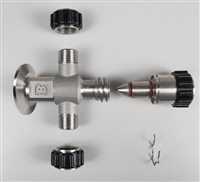
These instructions are applicable to any style of weldless bulkhead or ball valve including 2 and 3 piece versions. Common model numbers here are WLbulk, WL2PBV and WL3PBV. The instructions also apply to installing in most cylindrical beverage coolers except for the steps that involve drilling of course.
We are far from experts in plastic and its capabilities and limitations, but after over a year of providing sight glasses based on polycarbonate, we've come to understand quite a bit. In an effort to extend the life of your sight glass kits, there are few things you should be aware of regarding the handling and care of your kit.
The good news is that polycarbonate is an ideal plastic for this application and is durable, clear, and can handle exposure to high heats and typical cleaning chemicals within reason. The failure rate for these kits in a homebrewing setting is less than .2% over the course of a year and almost all the failures can be attributed to extreme exposure conditions. Let's review some of the situations that may increase the chance of a failure.
We made a video to show a typical installation of a weldless sight glass kit but this is also a written step by step guide. Our advice is to watch the video and then read the instructions (or print them out and follow along during the install). The install instructions are slightly different for a keg vessel vs. a normal pot so please be aware of the differences noted. This also includes tips for threaded the thermometer into the combo kits as well as how to cut